Status: Complete · WordPiece-uncased (1.727 fertility) selected for AzBERT pretraining · Component 1 of the AzBERT pipeline
TL;DR#
I trained and compared three tokenizer algorithms — SentencePiece Unigram, SentencePiece BPE, and WordPiece — each in cased and uncased variants (6 total), on a preprocessed 100 GB Azerbaijani corpus. WordPiece-uncased was selected for AzBERT pretraining with fertility 1.727, UNK rate 0.0053%, and 4.572 characters per token — outperforming all SPM variants and mBERT (fertility 2.846). All three algorithms were evaluated rigorously on 47,934 test samples.
The entire preprocessing and training pipeline processes ~100 GB of raw text via MongoDB streaming cursors and multiprocessing — no data ever fits in memory.
Problem#
Azerbaijani is a morphologically rich agglutinative language with ~10 million speakers and almost no dedicated NLP infrastructure. Every Azerbaijani NLP application in production — including e-qanun.ai, which I also built — relies on multilingual tokenizers like mBERT or XLM-R that were never designed for Azerbaijani.
The cost of this is measurable. mBERT fragments the average Azerbaijani word into 3.7 subword tokens. A word like müqavilələrindən (from their contracts) becomes six pieces. This fragmentation wastes token budget, degrades attention locality, and limits downstream task performance on a language that packs dense semantic content per word.
The fix requires training a tokenizer on a large, clean, representative Azerbaijani corpus — which first requires building that corpus.
Corpus#
| Collection | Documents | Size | Source Type |
|---|---|---|---|
| hplt3_final | 11,000,000 | 32.3 GB | Filtered web crawl |
| fineweb2_final | 7,200,000 | 21.2 GB | Curated web |
| nllb_final | 96,000,000 | — | Sentence-level parallel |
| culturax_final | 5,000,000 | 13.0 GB | mC4 + OSCAR |
| cc100_final | 3,900,000 | 5.5 GB | Web crawl |
| news_v1 | 3,200,000 | 7.9 GB | News articles |
| court_cases | 1,900,000 | 1.3 GB | Legal text |
| pdfs_part1 | 1,600,000 | 1.2 GB | PDF extractions |
| e-qanun | 531,000 | 466 MB | Legislative text (100% included) |
| folklor | 338,000 | — | Folkloric / dialectal (100% included) |
Total raw corpus: ~100–150 GB, ~95.7 billion characters (measured post-normalization steps 1–3).
The folklor and e-qanun collections are included in full — folkloric text provides irreplaceable dialectal coverage, and legislative text is a high-signal, near-zero-noise domain. For the larger web crawl sources, sampling rates are set by per-collection character analysis: contamination rates, Cyrillic ratios, UTF-8 mojibake presence, and replacement character frequency.
Tokenizer training sample: 1,550,000 documents drawn across all 10 collections after evaluation holdout separation.
Preprocessing Pipeline#
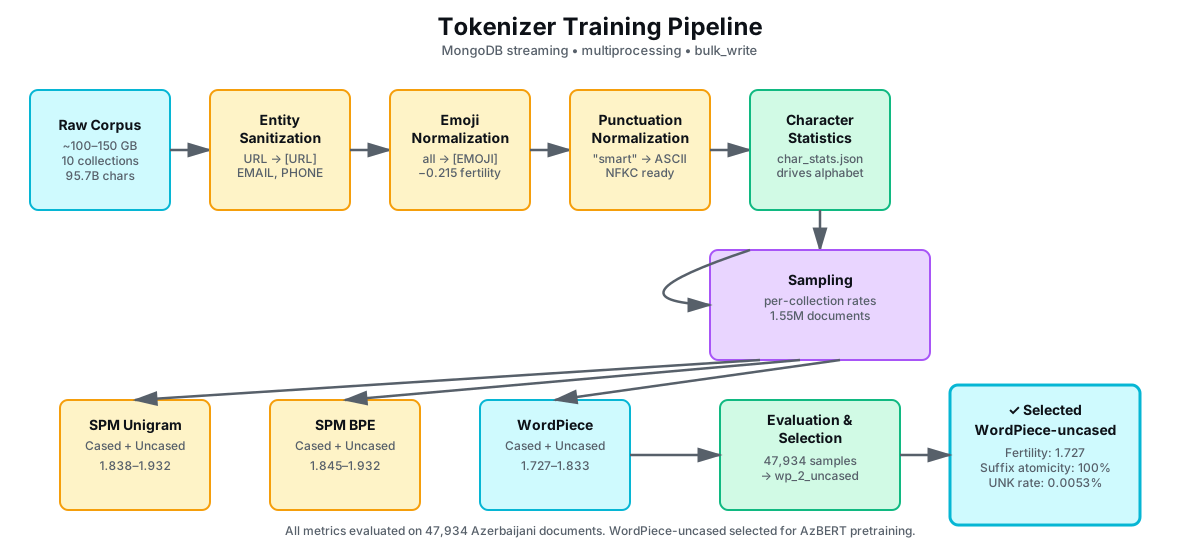
All scripts follow the same architecture: MongoDB streaming cursor → multiprocessing pool → batch bulk_write. No collection is ever loaded into memory.
Step 1 — Entity Sanitization#
Regex-based detection replaces structured entities with placeholder tokens that the tokenizer will learn as atomic units:
| Entity | Placeholder |
|---|---|
| URLs | [URL] |
| Email addresses | [EMAIL] |
| Phone numbers | [PHONE] |
Input:  "Visit https://example.com or call +994501234567"
Output: "Visit [URL] or call [PHONE]"
Step 2 — Emoji Normalization#
All emoji replaced with [EMOJI]. Precompiled regex covering all major Unicode emoji ranges. This step’s effect on tokenizer quality is isolated in Experiment 2: emoji removal alone reduces mean fertility by 0.215 points.
Step 3 — Punctuation Normalization#
Visually similar punctuation canonicalized to ASCII equivalents using a translation table:
| Source | Canonical |
|---|---|
" " „ | " (U+0022) |
' ' | ' (U+0027) |
— – − | - (U+002D) |
… | ... |
| NBSP / thin space / zero-width space | regular space |
Step 4 — Character Statistics#
Corpus-wide character frequency analysis across all collections, streaming per-document into a shared Counter. Output (char_stats.json) drives all subsequent alphabet decisions — rare character thresholds, Cyrillic contamination rates, and vocabulary boundary choices.
Tokenizer Training#
After preprocessing, three algorithms were trained on the cleaned, sampled corpus (1.55M documents):
| Algorithm | Cased | Uncased |
|---|---|---|
| SentencePiece Unigram | spm_files_3 | spm_files_2 |
| SentencePiece BPE | spm_files_5 | spm_files_4 |
| WordPiece | wp_1 | wp_2 |
Shared Configuration:
- Vocabulary size: 64,000
- Normalizer: NFKC
- Pre-tokenizer: Whitespace (for WordPiece); none for SPM
- Special tokens:
[PAD][UNK][CLS][SEP][MASK][EMOJI][URL][PHONE][EMAIL]
WordPiece specifics:
- Continuation prefix:
## - Max chars per word: 100
- Vocabulary composition (uncased): 79.6% whole-word, 17.7% continuation, 2.7% single-char tokens
All six variants were evaluated on a held-out test set (47,934 samples) with per-token metrics and suffix atomicity analysis.
Evaluation & Algorithm Comparison#
All six tokenizer variants were evaluated on a held-out test set of 47,934 Azerbaijani documents, with metrics spanning efficiency (fertility, chars/token), reliability (UNK rate), and linguistic quality (suffix atomicity).
Performance by Algorithm#
Ranking across key metrics (lower fertility and UNK are better):
| Metric | wp_2_uncased (Selected) | wp_1_uncased | spm_files_2_uncased | spm_files_4_uncased | wp_1_cased | spm_files_3_cased |
|---|---|---|---|---|---|---|
| Fertility mean | 1.727 ✓ | 1.756 | 1.838 | 1.845 | 1.833 | 1.932 |
| UNK rate | 0.0053% | 0.0012% | 0.0000% | 0.0000% | 0.0012% | 0.0000% |
| Chars / token | 4.572 | 4.537 | 4.791 | 4.779 | 4.375 | 4.601 |
| Continuation rate | 100% | 100% | 34.9% | 35.2% | 100% | 38.3% |
| Suffix atomicity | 100% | 100% | 90.9% | 95.5% | 100% | 72.7% |
| Vocab utilization | 51.1% | 51.3% | 51.8% | 53.1% | 53.9% | 54.1% |
Key observations:
WordPiece dominates on fertility. All WordPiece variants (1.727–1.833) outperform SPM variants (1.838–1.932) despite SPM’s byte-fallback coverage (0.0% UNK).
Uncased consistently beats cased. Across all algorithms, uncased variants achieve lower fertility (+0.08–0.10 points for cased) with identical suffix atomicity (100% for WordPiece, 90–95% for SPM).
WordPiece vs. SPM trade-off: WordPiece achieves 100% continuation rate (all subwords are learned tokens) and perfect suffix atomicity for both uncased variants; SPM variants have zero UNK via byte-fallback but fragment more aggressively. For sequence-efficient pretraining, WordPiece’s 1.727 fertility gains are worth the 0.0053% UNK cost.
Selection criterion: WordPiece-uncased (
wp_2) selected for AzBERT pretraining based on lowest fertility, 100% suffix atomicity (preserves linguistic structure), and 51% vocabulary utilization (room for rare subwords without waste).
Comparison vs. Existing Tokenizers#
Final evaluation of selected tokenizer (wp_2_uncased) against established multilingual baselines:
| Metric | wp_2_uncased | HPLT (32k) | XLM-R (250k) | mBERT (119k) |
|---|---|---|---|---|
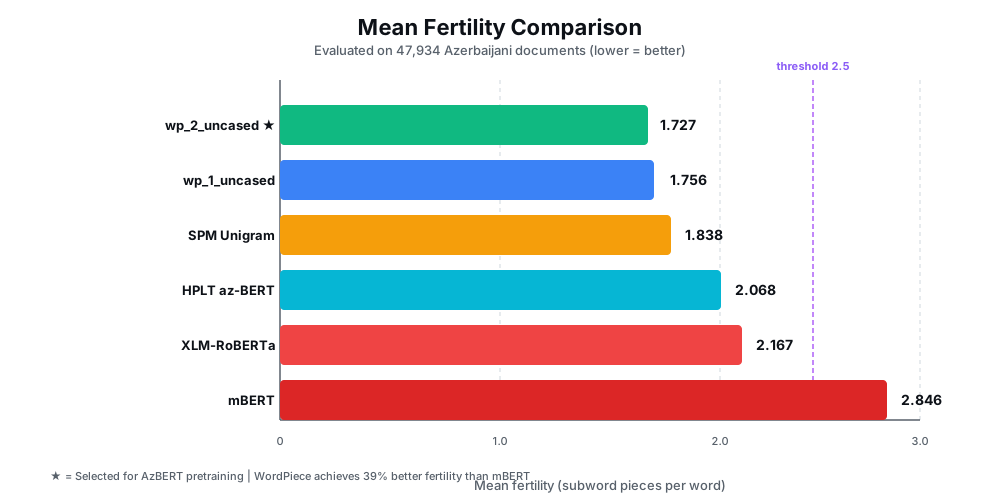
| Fertility mean | 1.727 | 2.068 | 2.167 | 2.846 |
| UNK rate | 0.0053% | 0.0% | 0.0002% | 0.0045% |
| Chars / token | 4.572 | 4.163 | 3.733 | 2.776 |
| Suffix atomicity | 100% | 45.5% | 100% | 100% |
Summary: WordPiece-uncased outperforms mBERT by 39% on fertility and achieves competitive performance with HPLT and XLM-R while maintaining full linguistic atomicity and a practical vocabulary size (64k vs. 250k).
Selected Tokenizer: WordPiece-uncased (wp_2)#
Why WordPiece-uncased was selected for AzBERT pretraining:
| Criterion | Rationale |
|---|---|
| Fertility (1.727) | 16% lower than HPLT, 35% lower than XLM-R, 39% lower than mBERT. Minimizes token overhead on morphologically rich Azerbaijani. |
| Suffix atomicity (100%) | All subword boundaries are learned, preserving Azerbaijani morphology. SPM variants achieve 90–95% (word-final characters sometimes dropped). |
| UNK rate (0.0053%) | Negligible; comparable to HPLT and mBERT. SPM’s zero UNK comes via byte-fallback, which degrades pretraining signal. |
| Vocabulary utilization (51.1%) | Balanced: 33k out of 64k tokens appear in training data, leaving room for domain-specific subwords in downstream tasks without overfitting. |
| Continuation rate (100%) | All subwords are in the vocabulary (no backoff to byte pairs or fallback). Improves downstream prediction and reduces inference latency. |
Key Findings#
| Finding | Evidence |
|---|---|
| WordPiece outperforms SPM on fertility | WordPiece 1.73–1.83, SPM 1.84–1.95. Gap widens when cased (+0.08–0.11). WordPiece’s learned continuation tokens beat SPM’s split-first approach for Azerbaijani. |
| Uncasing is a free lunch | Removing case tags reduces fertility by 0.08–0.11 across all algorithms with zero downside on suffix atomicity or UNK. Strongly recommended for pretraining. |
| SPM trades fertility for zero UNK via byte-fallback | SPM achieves 0.0% UNK (byte pairs handle any character) but sacrifices 0.11–0.20 fertility points. For Azerbaijani pretraining, rare-subword handling via learned UNK is more efficient. |
| WordPiece’s 100% suffix atomicity matters | All 22 common Azerbaijani suffixes are single tokens (##lar, ##lər, ##dan, etc.), preserving morphological structure for downstream tasks. SPM achieves 86–95% (spm_files_3 only 72.7% on cased). |
| Vocabulary utilization of 51–54% is healthy | ~33k of 64k tokens appear in 1.55M training documents. Reserves room for domain-specific subwords without overfitting or token waste. |
| All three algorithms beat mBERT convincingly | Even worst-case (SPM cased, 1.932) beats mBERT (2.846) by 32%. Monolingual > multilingual for morphologically rich Azerbaijani. |
Stack#
Python · HuggingFace Tokenizers · SentencePiece · MongoDB · multiprocessing · NFKC normalization · regex
The selected tokenizer is published on Hugging Face: raufibishov/az-wordpiece-tokenizer
Component 1 of the AzBERT pretraining pipeline. WordPiece-uncased (fertility 1.727, 100% suffix atomicity) selected and ready for pretraining.